

Her daughter had an entire team lined up before she was born. The mother had a sticky note with a phone number on it.
That image sits at the center of January, the postpartum platform its founder built after a month on her own couch, overwhelmed and certain she couldn’t be the only one. “I’m the type of person who has a plan and a backup plan for everything,” she says, “and childbirth blew through all of it in about a week.”
There was no single dramatic moment, she explains, only small ones stacking up. A career spent in healthtech, getting the right care to the right person at the right time, had trained her to see systems. Motherhood put her on the other side of the problem. “I got to see how differently the system shows up for the baby and for the mother.”
The Six-Week Myth
The gap, she is quick to say, isn’t a missing appointment. It’s fragmentation: an OB with one post-birth visit, a pediatrician focused on the baby, perhaps a lactation consultant or pelvic floor therapist if you happen to find one, none of them speaking to each other. “The mother ends up holding the whole picture together herself, at the exact moment she has the least capacity to do it.”
Then there is the number itself. Six weeks, she points out, is simply how long it takes the uterus to shrink back down. It was never a timeline for recovery. Worldwide, more than one in three women still live with a health problem caused by childbirth: pain during sex, back pain, incontinence, anxiety. The study behind that figure defines “long-term” as anything past six weeks, because that is where care usually stops. Thyroid function can stay unsettled for up to a year, and almost nobody screens for it unless the patient raises it.
“We’ve gotten better at saying postpartum matters,” she says. “We haven’t built enough of the care to back that up.”

A Village, Rebuilt
Her answer is a model borrowed from older wisdom. The founder grew up around East Asian postpartum traditions, among them zuo yuezi, Chinese for “sitting the month.” Versions exist in Korea, Vietnam, India and beyond, each with its own name and timeline but the same premise: for roughly a month to forty days, a new mother rests, eats warming, nutrient-dense food, and bonds with her baby, while family takes over everything else. “She isn’t expected to bounce back,” the founder says. “She’s expected to heal.”
What struck her wasn’t the specific customs but the belief beneath them, that a mother’s recovery deserves real structure and not just good intentions. Most of us no longer have that village built into our lives. “We live far from family, and the village has become a group chat and a search bar.”
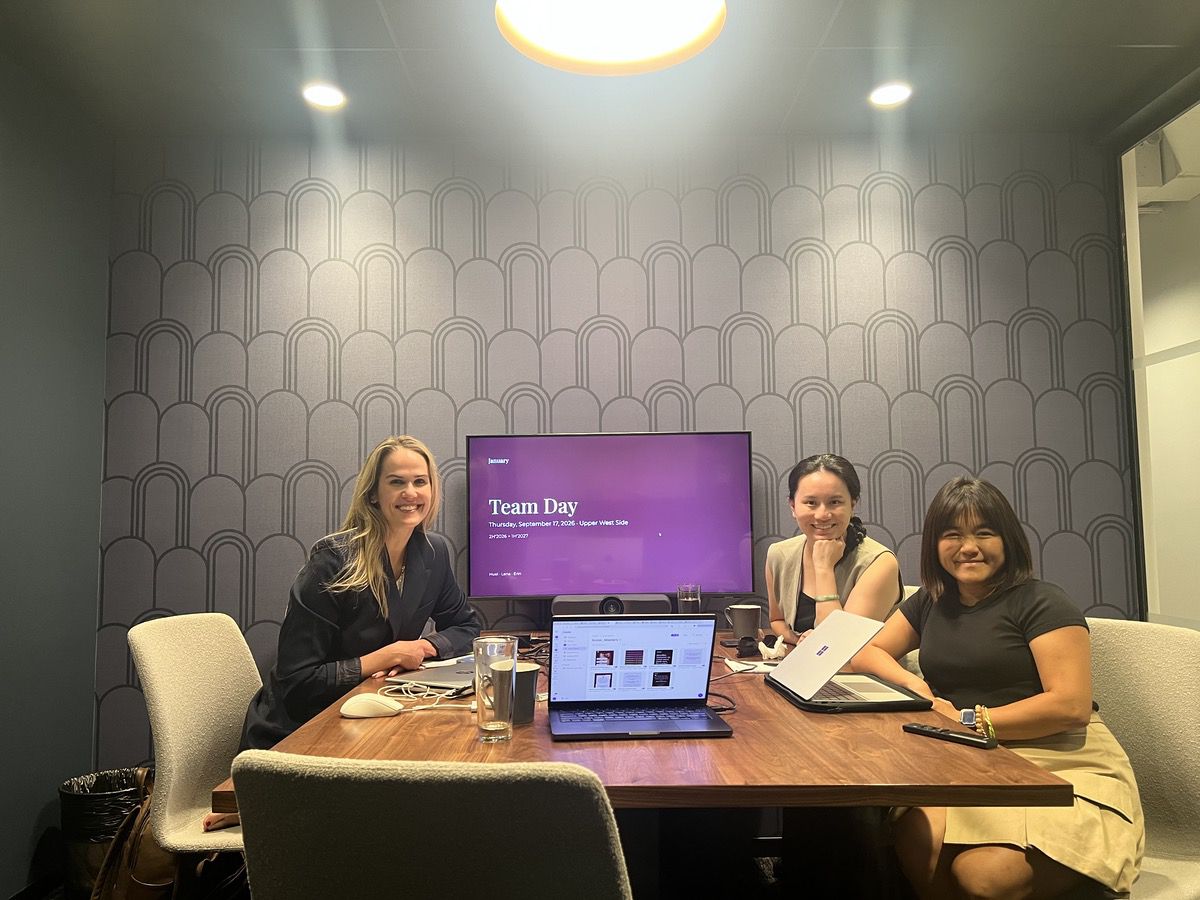
January is her attempt at a modern, medically grounded version. Its Care Plan is built around a woman’s actual delivery, feeding choices, health history and return to work, and it adapts as she does. The Symptom and Recovery Trackercatches problems early. The Care Concierge is the front door: text, and a real person answers. Behind it, protocols are built and reviewed by a clinical team led by Chief Medical Officer Dr. Lena Fan, a board-certified endocrinologist.
The division of labor is deliberate. “Technology is an amazing tool for efficiency and coordination,” the founder says. “But the oversight, the decisions that matter, and the moments that matter stay human.”
What Normal Looks Like
Fan’s rule of thumb is one the founder repeats often: normal recovery trends in one direction, even if it isn’t linear. Most weeks, it gets a little better. What deserves attention is anything that is getting worse, anything sudden, or anything that has stayed exactly the same for weeks.
The rule matters because of a quieter problem. About one in five women will experience a perinatal mood or anxiety disorder, and mental health conditions are the leading underlying cause of pregnancy-related death in the United States. Yet exhaustion, anxiety and fog are waved off as standard issue. Women minimize their symptoms, the founder says, “because they don’t want to seem like they’re overreacting.” January is designed as a place where nothing is too small to say.
It is also designed for the larger shift happening underneath the physical one. She invokes matrescence, the word an anthropologist coined in the 1970s for the process of becoming a mother, often compared to adolescence. “It’s hormonal, it’s mental, it’s identity, it’s quality of life, all shifting at once.” A plan that tracked only bleeding and stitches, she argues, would miss most of what is happening, so January also asks how a woman feels about going back to work and how she is adjusting to her body and her days.
Garnet and Janus
Then there is the look, which is unmistakably not pastel. Postpartum care, the founder says, has historically been “either clinical and cold, or completely absent,” and the soft palettes marketed as feminine “felt too fragile for the moment.”
January’s primary color is garnet: deep, warm, alive. It is the birthstone of the month, long associated with healing, courage, grounding and protection. “It reads almost like a checklist of what a woman actually needs in postpartum,” she says. The name carries a second layer. January comes from Janus, the Roman god of thresholds, usually pictured with two faces, one looking back and one forward. “I can’t think of a better picture of a woman in postpartum: still who she was, already becoming someone new.”
Her definition of luxury is a precise one. “Luxury has nothing to do with looking expensive. It’s about what luxury is supposed to deliver: feeling genuinely looked after, and being able to ask for something and have it handled.” Vulnerability, likewise, is not delicacy but honesty. The result is a brand that is “serious and tender in the same visual language, at the same time, instead of picking one,” with content streamlined enough that a member can absorb it “without it feeling like homework.”
On style more broadly, she resists easy pronouncements. Many women grieve parts of how they used to look or dress, she notes, while discovering they care less than expected about performing a certain version of themselves. “I don’t think there’s one universal shift. What I do think is that postpartum deserves the same permission to evolve, rather than pressure to snap back.”
The Goal Is to Be Boring
She is candid about what remains unfinished. Accessibility, she says, is something January is “actively building, not something we’ve solved,” with language access and partnerships with trusted providers and communities on the list. On the horizon are deeper clinical integration, so a Care Plan doesn’t live in a separate app from the rest of a woman’s care, and tools for partners, because the person supporting her at home “deserves real information too, not secondhand advice.”
Her ambition is best summed up in a word most founders avoid. “Honestly, I want it to feel boring one day.” A mother leaves the hospital with a real plan for her own recovery, not just a folder about the baby. She has more than one appointment that first year. Pelvic floor PT is a standing referral, not something found in a Facebook group. And if she says she doesn’t feel like herself, someone follows up. “None of that is complicated. We already know what women need.”
In five years, she hopes January is woven into health systems as what every mother is offered on her way out of the hospital, with insurers and employers covering postpartum support the way they cover prenatal care.
Asked what she would tell every new mother, she doesn’t hesitate. “Listen to your body. There’s no one-size-fits-all plan for postpartum, because there’s no one-size-fits-all postpartum.” Whatever you need, whether more sleep, asking for help, or actually accepting it, is the right plan. “You’re allowed to take your own recovery as seriously as you take care of your baby and your family.”
That, in the end, is the whole brief: that someone finally asks her how she’s doing, and means it.
- January’s founder is building the postpartum care system she needed: garnet-colored, clinically rigorous, and answered by a real person at 2am. - October 14, 2026
- BETWEEN TWO WORLDS - July 28, 2026
- The Art of Seth Lee: The Actor, Musician, and Model Redefining What It Means to Be Limitless - June 14, 2026
